The Work Around the Work
Robots may be able to perform a task without economically replacing the job around it. The same problem could shape the returns businesses see from AI agents.
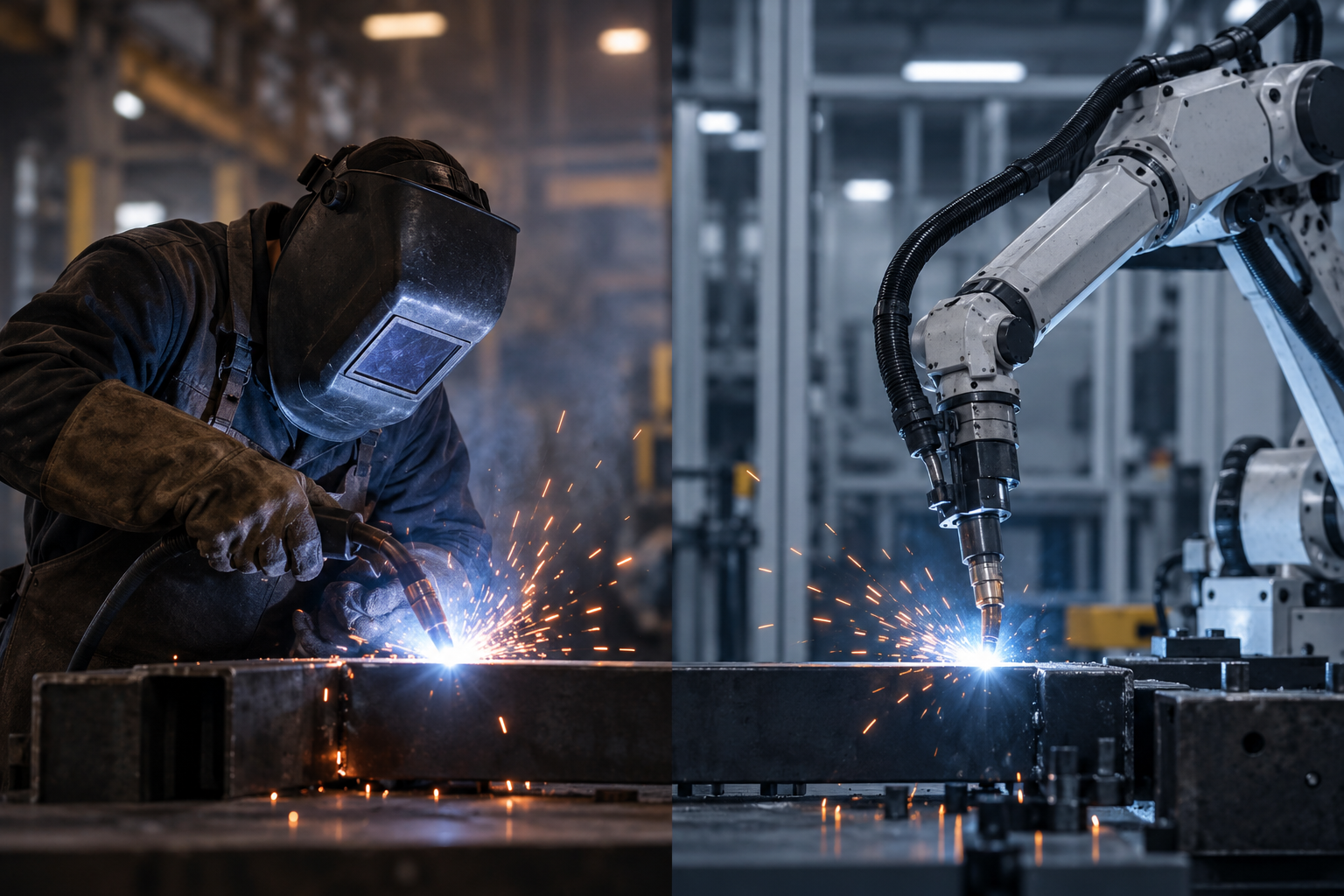
Robots have been welding metal for decades. In a factory, a robotic arm can make the same weld thousands of times with impressive precision. It’s easy to see why welding would seem like a good candidate for automation.
But a welder does quite a bit before picking up a torch. Pieces have to be fitted together and held in place. Some joints are awkward to reach, and the finished weld needs to be inspected, sometimes ground down or corrected. A human moves between these activities without giving much thought to where one task ends and another begins. Replacing the welding is relatively straightforward. Replacing the welder is harder.
Researchers at Anthropic put a price on that difference in a September 2026 study. They estimated that the combination of robots needed to perform a human welder’s various tasks would cost roughly five times as much as the human labor.
The welding example was part of a much broader examination of robotic capabilities. Across the US economy, the researchers estimated that existing robots could perform physical tasks representing about 34% of all working time, although much of that capability depends on specially designed environments. When they considered costs, however, robots were economically competitive with human labor for just 0.3% of working time.
It’s quite a gap, and I suspect something similar is developing with AI automation in businesses.
Consider a bank investigating a disputed transaction. An AI agent could review the customer’s complaint, retrieve account information, examine the transaction history, and prepare a proposed resolution. Given a representative case in a demonstration, it might appear that most of the process has been automated.
The actual business is rarely so accommodating. Records disagree, customers leave out information, and some decisions require additional approvals. The institution also has to document its reasoning, maintain appropriate controls, and deal with exceptions the agent can’t resolve. Much of that work takes place outside the activity the agent was designed to perform.
There’s already some evidence of how significantly this can affect costs. In an August 2026 analysis, McKinsey estimated that human oversight could account for 70% to 75% of the variable operating costs of AI agents handling certain banking customer-service activities. The model’s token costs represented just 20% to 25%. Those figures aren’t universal, but they illustrate how little of the expense may be associated with the technology itself.
Businesses have spent decades organizing work around the capabilities of people and the limitations of their systems. Along the way, they’ve accumulated specialized roles, handoffs, approval requirements, and procedures for handling unusual circumstances. Many of these arrangements exist for good reasons, although the reasons aren’t always apparent until someone tries to change them.
Introducing AI into those environments can make the central activity considerably faster without doing much to simplify the operation around it. And as the technology improves, the remaining work may account for an increasing share of the total cost.
That has an interesting implication for established businesses. A company could invest heavily in increasingly capable agents, automate much of the visible work, and still find that its operating expenses haven’t changed nearly as much as expected. Further improvements to the models might accomplish relatively little unless the company also reconsiders how the work is organized.
A new competitor could approach the same business differently. With fewer inherited systems and procedures to accommodate, it has an opportunity to design the operation around the capabilities of AI from the beginning. It still needs appropriate controls, accountability, and human judgment, but it may be able to provide them with far fewer handoffs and less organizational complexity.
That doesn’t mean established companies are destined to lose. Their customers, experience, and scale provide advantages that a new entrant may struggle to replicate. Still, there’s a possibility that the economics of automation will favor businesses willing to reconsider how they operate, rather than simply replacing individual activities with AI.
The robotics research doesn’t establish how quickly this will happen. Software agents have very different economics from physical machines, and some business processes are already producing substantial returns from automation. Yet the comparison offers a useful way to think about what those returns depend on.
For all the attention paid to what AI can accomplish, the larger economic opportunity may lie in reconsidering the work we’ve built around the things it can now do.
If AI can perform most of the work in a business, how much of that business would we have to rebuild before the economics actually change?
Algorithm & Blues publishes on Sundays. If this was forwarded to you, you can subscribe at joefuqua.blog.
References
- Legate-Yang, R., & Massenkoff, M. (2026, September 30). What work can robots do?. Anthropic.
- Asif, C., Kiewell, D., Hämäläinen, L., Kolaja, T., & Olanrewaju, T. (2026, August 24). Where AI agents pay off: A practical guide to the economics of agentic workflows. McKinsey & Company.
Get the next issue in your inbox
Algorithm & Blues publishes one clear argument per week on AI research, governance, and the long arc.